
A Mumbai court has granted anticipatory bail to Samajwadi Party MLA Abu Azmi in a case filed against him for his remarks praising Mughal ruler Aurangzeb. The court, however, cautioned Azmi to exercise restraint during interviews, warning that any irresponsible statement could spark riots. The case stems from Azmi's remarks during an interview where he praised Aurangzeb's rule and claimed that India's GDP during his reign accounted for 24 percent of the world's GDP. Azmi's lawyer argued that his client's statements were made spontaneously and without any malicious intent, while the prosecution opposed the bail plea, arguing that the remarks were made in a sensitive time following the release of a film based on the life of Chhatrapati Sambhaji Maharaj, a revered Maratha king who was captured by Aurangzeb. The court noted that the investigation was at a preliminary stage and that the investigating officer did not have the video recording of the interview when the case was filed. The court also expressed concern over the potential for Azmi's remarks to incite violence.

'For the first time in this country, perhaps the first time anywhere, we are going to use backwardness index.' 'It is a fundamental shift in the discourse in the country's social justice.'

Projection for economic growth in India for this fiscal was based on oil prices at $62 a barrel, he said, adding that a $10 dollar rise in oil prices mean 1.2 per cent reduction in India's GDP growth
'The government has to explain (to the army, air force and navy chiefs) whether they want a punitive strike, a deep punitive strike, or whether they want limited war or an all-out war, will it be a circumscribed war or will it be a shallow attack along the border.'

Goldman says the downgrade reflects the more difficult external funding conditions for Asia as markets increasingly anticipate Fed tapering and eventual exit from unconventional monetary policies.

Growth projections for 2013-14 has been arrived at by taking into account present internal and external factors.
Further, the agency said it expects signs of a pick-up to emerge in the second half of the year.

The report has identified some areas that need attention from India's policymakers.
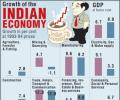
Overcoming a negative growth in mining sector and a meagre 2 per cent growth in agriculture, the economy continued on its upward trajectory, which was witnessed during the first quarter of the current financial year.

The paper said that the taxation proposal needs to be accompanied by explicit redistributive policies to support the poor, lower castes, and middle classes.

Attributing the decline to various global and domestic factors, especially poor performance of the manufacturing sector, the chamber called for 'immediate policy intervention' to deal with the situation.

'The bull market cycle ran for five years. It's the end of that cycle.' 'The next cycle is a down cycle, and in that down cycle, you will see the Sensex falling from their highs of around 68,000 to maybe 40,000-50,000 at the bottom of the cycle.'

Retail inflation eased to a nearly six-year low of 3.16 per cent in April mainly due to subdued prices of vegetables, fruits, pulses, and other protein-rich items, creating enough room for the Reserve Bank to go for another round of rate cut in the June monetary policy review. The Consumer Price Index (CPI) based inflation was 3.34 per cent in March and 4.83 per cent in April 2024. It was 3.15 per cent in July 2019.

'I believe that the overall demand for commercial vehicles will improve, even though there is a slowdown in the GDP.'

IMF cut its 2016 global growth forecast for the fourth time in the past year to 3.2 per cent, citing China's slowdown.

A majority of corporate honchos feel that reviving India's overall economic growth to seven per cent will be feasible in the next fiscal, a survey by industry body Assocham said.

In response to the panic triggered by Trump's trade policies, the RBI net sold approximately $43 billion in the second half of FY25 to curb volatility, as the rupee plunged to a low of 87.95 per dollar in February this year.
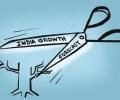
India's real GDP growth will decline marginally to 6.3 per cent in 2024 from the 6.4 per cent estimated for 2023, an American brokerage firm said on Monday. The next calendar year will be of two halves, wherein the government spending before the upcoming General Elections will be the key driver for growth, while after the elections, it will be the re-acceleration in investment growth, especially from the private sector, Goldman Sachs said in a report. From a fiscal year perspective, the brokerage said it expects growth to accelerate to 6.5 per cent for FY25 from the 6.2 per cent it has projected for the ongoing FY24, it added.

Growth in corporate profits needs to be commensurate with wages to boost the economy, Economic Survey 2024-25 said, noting that sharp disparities between the two pose risk to the economy by curbing demand. The document tabled in Parliament on Friday noted that while the labour share of GVA (gross value added) shows a slight uptick, the disproportionate rise in corporate profitsredominantly among large firmsaises concerns about income inequality.
Differing with International Monetary Fund's growth forecast of 4.9 per cent for India during 2012, Planning Commission Deputy Chairman Montek Singh Ahluwalia said it has a statistical problem.
The European Union on Thursday said India will surpass 7.0 per cent growth this year and the new United Progressive Alliance government is expected to continue with reforms, including reduction in fiscal deficit.
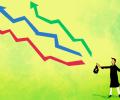
Investors would track a host of macroeconomic data announcements scheduled this week, including inflation numbers, and also monitor global market trends, and trading activity of foreign institutional investors, analysts said. The ongoing quarterly earnings announcements and the rupee-dollar trend would also influence the markets.

Amid rising global commodity prices and high inflation, the government is likely to scale down India's GDP growth projection for the 2011-12 financial year next month from 9 per cent estimated in February, chief economic advisor Kaushik Basu on Friday said.
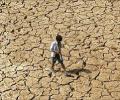
About 60 per cent of net sown area of the country is rain-fed. With every one per cent deficit in rains, the country's gross domestic produce falls by 0.35 per cent.


Corrosion is a big menace for anything with steel application from rebars in construction, oil and water pipelines, railway track, power distribution poles to automobiles, says Kunal Bose.

India's largest IT services firm Tata Consultancy Services on Thursday reported a 1.68 per cent dip in its consolidated net profit to Rs 12,224 crore for the March 2025 quarter. Tata Consultancy Services (TCS) - whose earnings marked the official start of IT results season - reported a total revenue of Rs 64,479 crore in Q4 FY25, up 5.3 per cent over the year-ago period.
India's real GDP is expected to grow at an impressive 9.5 per cent in FY'09, the Centre for Monitoring Indian Economy said in its monthly review in Mumbai. The Indian economy is heading towards the fourth consecutive year of an over 9 per cent growth and like in the last five years, growth this year too was expected to be driven by capital investments happening in India, CMIE said.

India's central bank has however, forecast an 8.2 per cent economic growth in FY 11.

While the capital spending is being maintained at 3.1 per cent of the GDP, a little more would have boosted economic growth even further, suggests Rajiv Memani.

Neither the BJP, nor the Congress before it, made any manifesto commitments on defence spending, even though allocations have plummeted from 4 per cent of gross domestic product (GDP) in the late 1980s to less than 2 per cent today, points out Ajai Shukla.
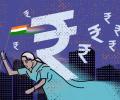
The government's indirect tax collection is expected to increase by 8.3 pc in the financial year 2025-26 (FY26), according to a report by ICICI Bank. The report also noted that this growth is higher than the 7.1 per cent increase seen in FY25 and is mainly driven by rise in GST revenue from strong urban consumption. It said "The increase is driven by higher goods and services tax collections which in-turn is explained by boost to urban consumption".

Fitch Ratings on Tuesday raised India's growth forecast for the current fiscal to 7.2 per cent, from 7 per cent projected in March, saying elevated consumer confidence will drive spending, besides increased investments. In June update to its global economic outlook report, Fitch said it expects inflation to decline to 4.5 per cent by end of this year and RBI to cut policy interest rates by 25 basis points to 6.25 per cent.

Niti Aayog CEO Amitabh Kant said only farm revolution can make it possible. He also stressed on scrapping Agriculture Produce Marketing Committee and some old laws like Essential Commodites Act, which restrict movement of farm produces.

'If the US stagnates and falls into a recession, the dollar will weaken, oil prices will also dip. This augurs well for India.'

We no longer have the ambition to rival China save through words. We are happy to be fighting ourselves and digging up disputes from centuries ago as a substitute for real development, argues Aakar Patel.

Escalating trade tensions amid a tariff war after Donald Trump took over as President of the United States (US) could adversely impact global growth and fuel inflation, an article on the "State of the Economy" in the Reserve Bank of India (RBI) monthly bulletin said.

However, the growth during the next financial year would be higher at 8.1 per cent in case of a second wave of the coronavirus and bit slower at 7.9 per cent if the virus recedes and remains under control.

In an eventful week ahead, stock markets may face volatile trends before the RBI's interest rate decision and the US inflation data announcements, as investors continue to assess the broader implications of US tariffs on global economy and inflation, analysts said. Investors fear that a full-blown trade war will impact global trade and economic growth, according to market experts.

More than 80 per cent of Indians live in districts vulnerable to climate risks. Among these, Assam, Andhra Pradesh, Maharashtra, Karnataka, and Bihar are the most vulnerable states to extreme climate events.
 © 2026 Rediff.com - Advertise with us - Disclaimer - Privacy Policy - Sitemap - Feedback - About us - Terms of use - Grievances